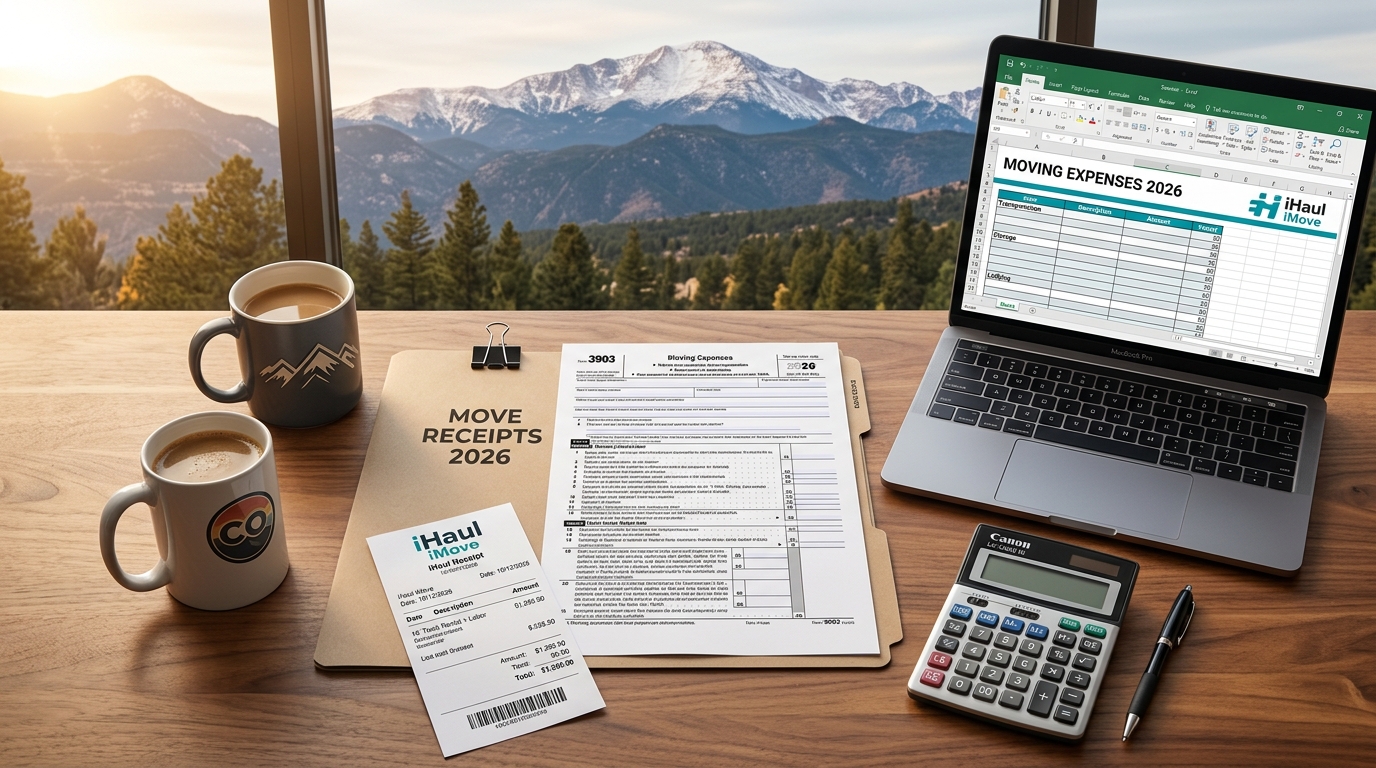
Can I Claim Moving Expenses on My Taxes in Colorado? (2026)
iHaul iMove Team
Moving Expert
Can you claim moving expenses on taxes in Colorado for 2026? For most filers, no — the TCJA suspended the deduction through 2025. Active-duty military are the key exception.
Can you claim moving expenses on your taxes in Colorado for 2026? For most filers, the short answer is no. The Tax Cuts and Jobs Act (TCJA) suspended the federal moving expense deduction starting in 2018 and extended through tax year 2025, and Colorado conforms to the federal rule. The biggest surviving exception — and the one that matters in Colorado Springs — is active-duty military members moving under permanent change of station orders.
At iHaul iMove, we move thousands of Colorado Springs families every year, and a huge percentage are juggling relocation alongside tax season. The single most common tax question we get: “Can I write off this move?” Here is the honest, source-cited answer for 2026 — including who still qualifies, what records to keep, and how Colorado handles employer-paid relocations.
This article is general education, not tax advice. Tax law changes, and your situation has details we cannot see. Confirm with a CPA, an enrolled agent, or IRS.gov before you file.
The Short Answer for Civilians: No (For Now)
The Tax Cuts and Jobs Act of 2017 suspended the moving expense deduction and the employer-provided moving expense exclusion for tax years 2018 through 2025 for all taxpayers except active-duty members of the U.S. Armed Forces moving under military orders. That language comes directly from IRS Publication 521 and the IRS Topic No. 455 page.
As of this article’s June 2026 publication, Congress has not extended a broader moving expense deduction for civilian taxpayers beyond the TCJA window. If that changes mid-year — or in a future bill — the IRS will publish updated guidance, and your tax preparer will know first. Always check the current year’s IRS Publication 521 before assuming the rules.
What this means in plain English
If you are a civilian who moved within Colorado, into Colorado, or out of Colorado in 2025 — for a new job, a promotion, retirement, family reasons, or any other personal reason — you generally cannot deduct your moving costs on your federal return, and Colorado’s conformity rules mean you cannot deduct them on your state return either.
The Big Exception: Active-Duty Military
If you are an active-duty member of the U.S. Armed Forces and you moved under a permanent change of station (PCS) order, you can still deduct unreimbursed moving expenses using IRS Form 3903.
This matters in Colorado Springs more than almost anywhere else in the country. We are home to:
- Fort Carson (Army)
- The U.S. Air Force Academy
- Peterson Space Force Base
- Schriever Space Force Base
- Cheyenne Mountain Space Force Station
Every PCS cycle, we help service members navigate the deduction — see our full military relocation service for the complete play-by-play on PCS moves.
What active-duty military can deduct
Per IRS Publication 521 and the Form 3903 instructions, eligible expenses generally include:
| Category | Examples |
|---|---|
| Household goods & personal effects | Cost of packing, crating, transporting, and in-transit storage |
| Travel to the new duty station | Mileage (at the IRS-published moving rate), tolls, parking, lodging |
| Shipping vehicles & pets | Reasonable costs to ship a vehicle or pet to the new station |
What is not deductible: meals during the move, house-hunting trips, temporary lodging beyond what is needed in transit, and any costs that are reimbursed by the military.
What to keep
If you are PCS-ing, keep every receipt that has anything to do with the move. The IRS standard for reasonable documentation includes:
- Moving company invoices (iHaul iMove provides itemized invoices automatically)
- Fuel receipts and a mileage log
- Lodging receipts during travel
- Storage receipts (in-transit storage is generally covered; long-term is generally not)
- Vehicle shipping invoices
- Pet transport receipts
The IRS allows the moving mileage rate published each year. For 2025, check the latest IRS announcement before claiming.
Does Colorado Have Its Own Moving Expense Deduction?
Short answer: no, not separately for civilians.
Colorado’s personal income tax starts with federal taxable income as the base, then applies state-specific additions and subtractions. Because the federal moving deduction is suspended for civilians, there is nothing to flow through to your Colorado return either.
For active-duty military, the federal deduction does flow through — meaning if you qualify federally on Form 3903, you effectively benefit on your Colorado return as well, because your federal taxable income is already lower.
Colorado specifics change occasionally. The Colorado Department of Revenue FYI Income series is the authoritative source. When in doubt, talk to a CPA who handles Colorado returns — there are several excellent firms in Colorado Springs, Denver, and Castle Rock.
Employer-Paid Relocation: What’s Taxable in 2026
Many Colorado Springs movers we help are relocating for a corporate job — defense contracting, tech, healthcare, the trades, you name it. If your new employer is reimbursing or directly paying for your move, the rules changed dramatically under TCJA.
Civilian employer reimbursements
Any moving expense reimbursement an employer pays to a civilian employee is generally treated as taxable wages. That includes:
- Direct payments to a moving company on your behalf
- Reimbursements to you for moving expenses
- “Relocation bonuses” or “sign-on bonuses” tied to a move
- House-hunting trip reimbursement
- Temporary lodging reimbursement
These amounts show up on your W-2 in Box 1 and are subject to federal income tax, Social Security, Medicare, Colorado state income tax, and any applicable local taxes.
Gross-up policies
Because moving reimbursements are taxable, many employers offer a gross-up — they pay you extra to cover the tax hit so your move is effectively cost-neutral. If your offer letter mentions a “relocation package,” ask HR specifically:
- Is the reimbursement grossed up?
- Will I get a written summary of what’s taxable?
- Are there caps or claw-back rules if I leave within X months?
Active-duty military reimbursements (still excludable)
If you are active-duty military and your reimbursement is for a qualified move, it is generally excludable from income — meaning it does not show up as taxable wages. Different rules entirely.
What If I Moved in 2025 for a New Job — Anything I Can Do?
For a civilian who relocated for work in 2025, the federal moving expense deduction is off the table. But that does not mean there is nothing to do.
Things still worth tracking
- Selling costs on your old home. Real estate commissions, transfer taxes, and most closing costs reduce your capital gain when you sell — separate from the moving deduction.
- Mortgage points on your new home. Points paid to buy down a rate on a primary residence are generally deductible as mortgage interest. Talk to your CPA.
- Home office expenses. If you work from home in your new place, you may qualify for a home office deduction (self-employed) or an accountable plan reimbursement (W-2 with the right employer setup).
- State income tax differences. If you moved into Colorado from a higher-tax state — say, California — there may be part-year resident allocations worth optimizing.
Things that will NOT save you taxes
- Receipts from a civilian move “just in case Congress reinstates the deduction”
- Self-employed status by itself (you cannot deduct personal-move costs even as a 1099 worker; only legitimate business-relocation costs of business assets)
- “Moving for medical reasons” — this is not a recognized exception under current federal law
Recordkeeping Checklist (Active-Duty Military)
If you are PCS-ing into or out of Colorado Springs, build a single “PCS receipts” folder — physical or digital — and dump everything in it. At year-end, your tax preparer or a self-prep tool will sort it out.
Keep these documents
- Your PCS orders (proof of the move qualifying)
- Moving company invoice(s), itemized
- Packing supplies receipts (if not provided by mover)
- In-transit storage invoices
- Fuel receipts and a mileage log for the trip
- Lodging receipts during travel (not meals)
- Vehicle shipping invoices
- Pet transport invoices
- Any DLA/DLE/MALT/PPM paperwork from finance
- A copy of your prior-year return for reference
A note on PPM moves
If you executed a Personally Procured Move (PPM, sometimes still called a “DITY”), the reimbursement and tax treatment have their own rules. The government pays you a percentage of what they would have paid a transportation service provider, and a portion may be taxable. Coordinate with your finance office and your tax preparer before assuming the deduction line on Form 3903 applies cleanly.
When to Talk to a CPA (Not a Mover)
We are a moving company. We are very good at moving households and very specifically not a tax firm. Use this article as a starting framework, then talk to a professional if any of the following apply:
- You are PCS-ing and unsure how to fill out Form 3903
- You moved partway through 2025 and are filing a part-year Colorado return
- Your employer offered a relocation package and you do not understand the W-2 treatment
- You executed a PPM and the finance office’s paperwork is confusing
- You moved from a community-property state (CA, AZ, TX, etc.) into Colorado mid-year
- You are self-employed and tried to write off a personal move as a business expense (please do not)
Most Colorado Springs CPAs and EAs offer a free 15-minute consultation. For one move’s worth of tax complexity, that is often all you need.
A Quick PUC Note on Mover Invoices
Whether you can deduct your move or not, insist on a transparent written invoice from your moving company. Colorado PUC licensed movers (iHaul iMove operates under HHG-00281, continuously licensed since 2010) issue itemized invoices showing labor hours, materials, fuel/mileage where applicable, and any add-on services.
Even civilians who cannot deduct the move benefit from a clean invoice: it documents your basis for insurance claims, helps with any reimbursement disputes, and gives you a record if a future tax change ever makes the move retroactively deductible.
Ready to Plan Your Colorado Move?
iHaul iMove has helped over 8,000 Colorado Springs families relocate since 2008, including hundreds of PCS moves into and out of Fort Carson, Peterson SFB, Schriever SFB, and the Air Force Academy. BBB A+, 900+ five-star Google reviews, 2026 Best of the Springs Gold Movers winner. We will give you the itemized written estimate your tax preparer wants to see — no surprise fees.
Prefer to talk it through? Call 719-357-5865. We are open 24 hours, and our office can walk you through what a typical local, long-distance, or military move invoice looks like — so you and your tax preparer are not guessing in April.
The Bottom Line on Claiming Moving Expenses in Colorado
For 2026:
- Civilians: generally cannot deduct moving expenses, federally or on Colorado returns
- Active-duty military with PCS orders: can still deduct unreimbursed expenses on Form 3903
- Employer reimbursements (civilians): treated as taxable wages
- Employer reimbursements (qualified military): generally excludable
- State of Colorado: conforms to federal — no separate civilian moving deduction
- Always: check the current year’s IRS Publication 521 and ask a tax professional
If Congress changes the rules — and there has been periodic talk of restoring some form of the civilian deduction — we will update this guide. Until then, keep the receipts if you are military, and lean on a CPA for anything edge-case.
help Frequently Asked Questions
Can I claim moving expenses on my taxes in Colorado for 2026? expand_more
Who can still deduct moving expenses? expand_more
Does Colorado offer its own moving expense deduction? expand_more
What moving expenses can active-duty military deduct? expand_more
Is employer-paid relocation taxable in 2026? expand_more
Written by iHaul iMove Team
The iHaul iMove team has over 18 years of experience moving families across Colorado. We share our expert knowledge to help make your next move your best move.
See About Us →Ready to make your move?
Get a guaranteed price quote for your move in Colorado Springs. No hidden fees, just honest service.
Experience Our Unwavering Promise
At iHaul iMove, punctuality, transparency, and the meticulous care of your property are not just policies—they are our unwavering promise. If we're not 5 minutes early, we consider ourselves late. Discover the difference of a truly dedicated moving partner.
Contact Our Team
Call Us 24/7
719-357-5865Email Us
info@ihaulimove.comLocation
Colorado Springs, CO
Hours
Open 24 hours a day